by Alfred Jarry
translated by Samuel Lees

ANTHROPOPHAGY
Anthropophagy, that too neglected branch of anthropology, is not dying ― no, anthropophagy is not dead.
There are, as we all know, two ways to do anthropophagy: one can eat human beings or be eaten by them. There are also two ways to prove that one has been eaten. For now we will only consider the first: unless La Patrie has embellished the truth, in the issue dated the seventeenth of February, the anthropophagic mission they sent to New Guinea would have been a complete success, so complete indeed that none of its members would have returned, save the two or three specimens that the cannibals spare, according to custom, in order to convey their compliments to the Geographical Society.
Before the arrival of the anthropophagic mission, it is probable that, among the Papuans, this science was still in its infancy: they lacked the rudiments of the art, dare we say, the ingredients. The savages do not eat one another. Furthermore, it has become clear from several investigations by our daring military explorers in Africa, that the coloured races are inedible. We therefore should not be surprised by the enthusiastic welcome the cannibals extend to their white visitors.
Nevertheless it would be a grave error to see in the massacre of the European mission nothing but base gluttony and pure culinary interest. This event, in our opinion, demonstrates one of the most noble tendencies of the human spirit, its propensity to assimilate that which it finds good. It is a very old tradition, among most warlike people, to devour this or that part of the body of its prisoners, in the belief that they possess some virtue: the heart, courage; the eye, perspicacity, etc. Queen Pomare’s name literally means « eye-eater ». However, belief has shifted away from such simple notions of localised virtue, and since then this custom has been less observed. But one finds it, preserved, in the sacraments of various religions, based on theophagy. The Papuans had nothing else in mind, when they devoured the explorers of the white race, other than a sort of communion with their civilisation.
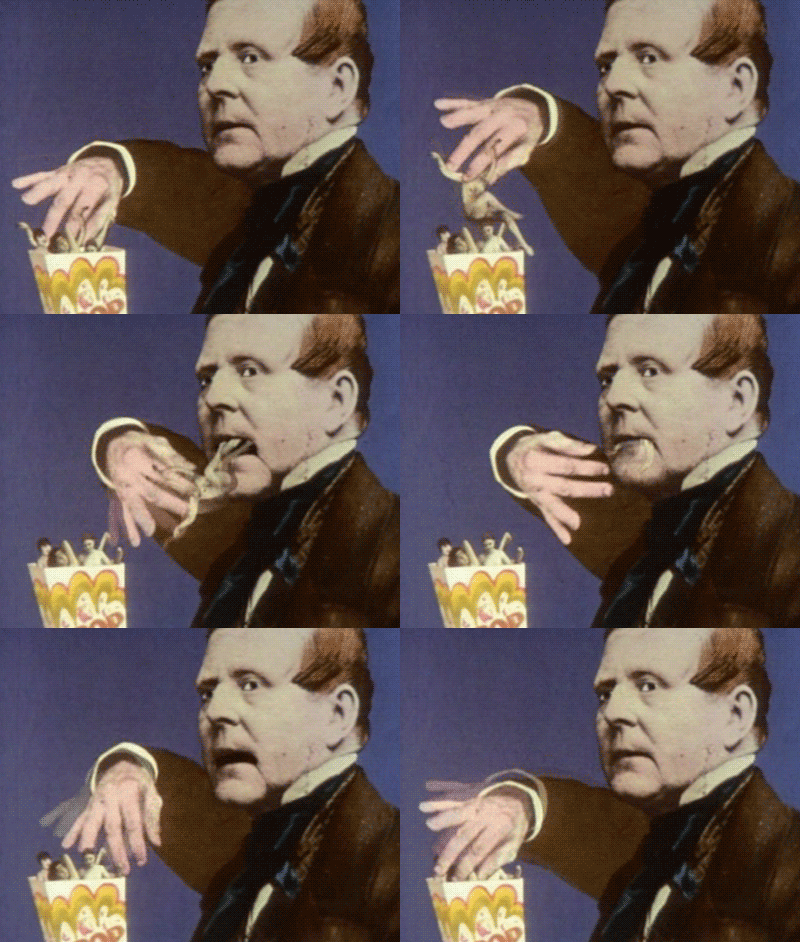
If some vague carnal desires have crept into the performance of this rite, they were suggested to them by the leader of the anthropophagic mission himself, Mr. Henri Rouyer. It has been widely remarked that he speaks with insistence, in his relation, of his friend « the good fat Mr. de Vriès ». The Papuans, unless one supposes them excessively stupid, could not but surmise that: good means good to eat and fat means there will be some for everyone. It was difficult for them not to form, of Mr. de Vriès, the idea of a living food reserve embarked for New Guinea. How could they (the explorers) say that he was good without having had a chance to appreciate the quality, and the quantity of his corpulence? Besides, anyone who has read tales of travel will know that explorers think of nothing but food. Mr. Rouyer avows that, in times of scarcity, he « stuffed his mouth with worms, caterpillars, grasshoppers, termites… rare species of insects new to science. » To the aboriginals this research into rare insects must have seemed a refined form of gluttony. As for the collection boxes, they must have taken them for extraordinary reserves designed to satisfy the cravings of perverted stomachs, just as those of the anthropophagi seem to us civilised people.
Foitar, the chief of the Papuans, proposed to hand over two prisoners of war in exchange for Mr. de Vriès and Aripan, the servant boy. Mr. Rouyer, appalled by this suggestion, refused the offer… He then recovered the two prisoners of war by stealth. We see no difference between this operation and that of the swindler who refused, with equal aversion, the offer to pay a sum for the acquisition of one or several legs of lamb, and then swiped the edible limbs when, in good faith, the butcher had turned his back. Mr. Rouyer stole the two prisoners. When Mr. Foitar, the chief of the Papuans, took delivery of the boy and Mr. de Vriès, he was only claiming what was legitimately his, as compensation for his loss.
There is, we began by announcing, a second way for an anthropophagic mission not to return, and this method is the quicker and more reliable of the two, and that is if the mission does not go in the first place.
 Samuel Lees