or
The Fantastic Vexations of an Admirer of Hoffmann
By Théophile Gautier
Translated by Samuel Lees
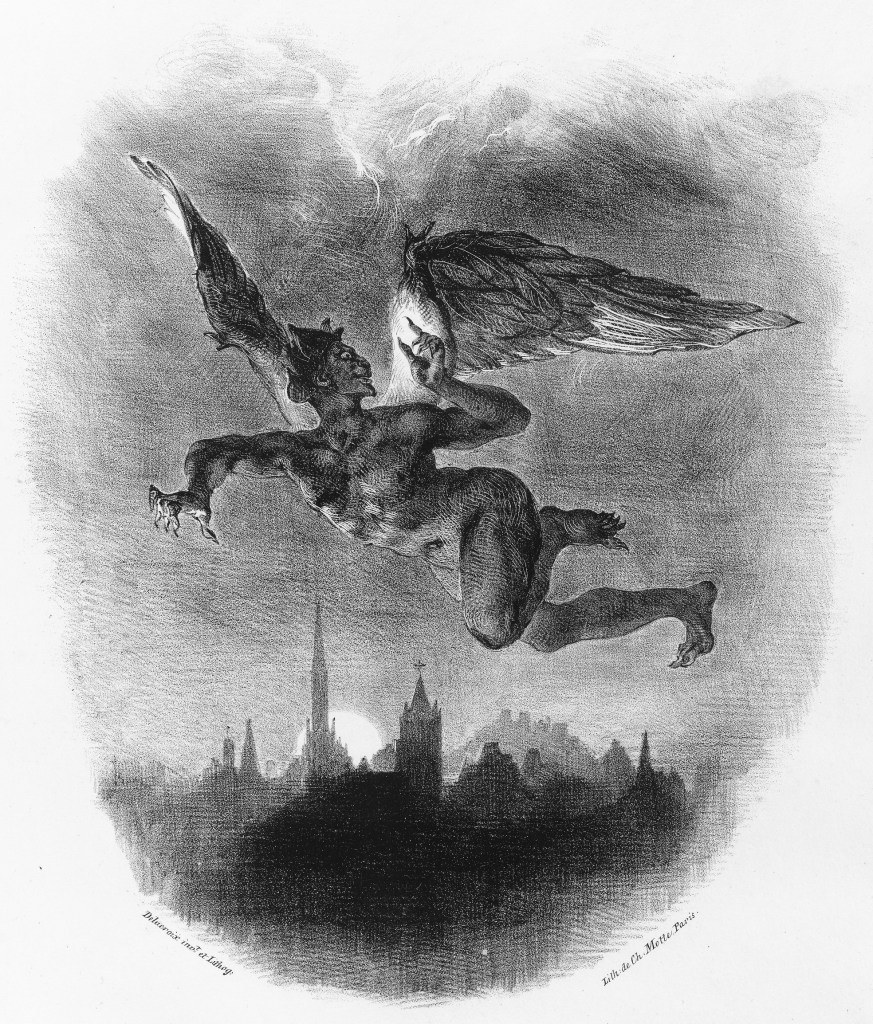
He thought clouds were saucepans, and bladders were lanterns.
― Gargantua, Book 1, Chapter 11
Ding! ding! ding!
No response.
― Is he not at home? said the young girl.
She pulled the bell cord a second time. Nothing could be heard from within the apartment. There was no one there.
― That’s odd!
She bit her lip. A spiteful blush migrated from her cheek to her brow. She began to descend the stairs one by one, very slowly, as if with reluctance, turning her head from time to time to see if the fatal door had opened.
Nothing.
At the corner of the road, she saw Onuphrius in the distance. He was walking on the sunny side of the street, without a care in the world, pausing at every window, watching the dogs fight and the children playing hopscotch, reading the inscriptions on the wall, spelling out the names of shops, like a man who has an hour ahead of him and is in no need to hurry.
When he caught sight of her, his eyes leapt from their sockets. He had not expected to find her here.
― What! you, already! ― What time is it?
― Already! how gallant. As for the time, I should not have to tell you anymore, you should know it by now, the young girl replied in a sullen tone, taking his arm; it’s half past eleven.
― Impossible, said Onuphrius. I passed Saint Paul’s not five minutes ago. It was only ten o’clock. If I tell a lie, I will put my hand in the fire. That is a bet.
― Don’t put anything in the fire and don’t make bets, you will lose both.
Onuphrius would not admit fault. As the church was just down the road, Jacintha wanted to go and settle the matter. Onuphrius could not have been more confident. As they walked, he practiced a smirk in the mirror of his mind. A short time later they arrived in front of the church.
― Well then, would you look at that! said Jacintha.
If instead of the dial, he had found the sun or moon in its place, he would have not been any more amazed. He removed his monocle, gave the glass a good polish with his handkerchief and rubbed his eyes to clear his view. The big hand was going to meet its little sister on the X of midday.
― Noon! he muttered between his teeth. A devil must have had a merry time moving the hands. I’m sure it was ten o’clock when last I looked.
Jacintha was good; she did not insist. Together they walked to his studio, as Onuphrius was a painter, and, at that moment, was doing her portrait. She sat in her usual pose. Onuphrius took the canvas, which was turned towards the wall, and placed it on the easel.
Above Jacintha’s delicate mouth an unknown hand had drawn a pair of moustaches that would have made a drum major proud. The rage of the artist at seeing Jacintha’s upper lip thus defiled is not hard to imagine. If it were not for her entreaties, he would have destroyed the painting. He tried as best he could to remove the badge of virility, not without swearing more than once at the knave who had made this beautiful addition to his work. But, when he wanted to resume painting, he found that his brushes, though he had soaked them in oil, were so stiff and bristly, that he could not possibly use them. He was obliged to send for others. While he waited, he took up his palette and made up the various tones he required.
Another ordeal: it was as if the tubes were full of lead. No matter how hard he tried, he could not make the colour come out, or else they exploded suddenly like little bombs, spitting ochre, lacquer and bitumen all over the place.
If he had been alone, I think that in spite of the first commandment of the Decalogue, he would have pronounced the name of the Lord more than once. He governed himself, the brushes arrived, he set to work; the next hour went by like a dream.
The blood began to flow beneath the skin, contours emerged, forms were sculpted, light and shadow separated, half of the painting was alive already.
The eyes were particularly worthy of praise. The arch of the eyebrows was reproduced perfectly; it melted smoothly towards the temples in bluish velvety tones. The shadow of the eyelashes softened the brilliant whiteness of the cornea with wonderful effect. The eyes were clear. The pupil and the iris left nothing to be desired. It only needed that little diamond of light, that little sparkle that painters call the visual point.
To enchase this diamond in her jet disc (Jacintha had black eyes), he took the finest, the most delicate of all his brushes: three hairs taken from the tail of a sable.
He dipped his brush towards the end of his palette in the silvery white that rose above the ochres and Sienna, like a snow-clad peak surrounded by black rocks.
You would have thought, to see the brilliant point trembling on the tip of his brush, a dewdrop on the end of a needle. He was just about to place it on the pupil when he received a violent nudge to the elbow which caused his hand to deviate, leaving the white dot on the eyelashes, and grazing the cheek that he had just finished and which was still wet with the cuff of his shirt. He span round so abruptly at this new catastrophe that his stool was sent reeling across the room. He did not see any one. If someone had found themselves there by accident, he would almost certainly have killed them.
― Unbelievable! he said to himself, deeply troubled. Jacintha, I’m not in good form. That will be all for today.
Jacintha got up to leave.
Onuphrius wanted her to stay awhile. He took her in his arm. Jacintha’s dress was white. His fingers, which he had not thought to clean, made a rainbow.
― You fool! said the young girl, look what you’ve done! You know my aunt does not want me to see you on my own. What is she going to say when she sees this?
― You will change dress, she won’t see a thing.
And he kissed her. Jacintha did not resist.
― What are you doing tomorrow? she said after a pause.
― Me, nothing and you?
― My aunt and I are going to dine with old Mr. de ***, whom you know, and perhaps I will spend the evening.
― I’ll be there, said Onuphrius, you can count on me.
― Don’t come later than six o’clock. As you know, my aunt is a coward, and if at the table there is not a gallant knight who can be our chaperon, she will leave before it gets dark.
― Fine, I’ll be there at five. See you tomorrow, Jacintha, see you tomorrow.
He leaned on the railings to watch the svelte form of the young girl as she left. When the last folds of her dress had disappeared beneath the arcade, he went back inside.
Before going any further, some words on Onuphrius. He was a young man between twenty and twenty-two years of age, though at first glance he seemed older. There was something childish and unrestrained in his pale and tired features, some signs of transition from adolescence to virility. His brow was serious and thoughtful like that of an old man, whilst the corners of his mouth were almost untouched by the bluish shadow that spread across his upper lip. A youthful smile curled his rosy lips which contrasted strangely with the pallour of his cheeks and the rest of his face.
Being this way by nature, Onuphrius could not avoid seeming a bit odd, but his natural strangeness was enhanced still by the cut of his hair and clothes. His hair, parted at the front like a woman, fell symmetrically along his temples, all the way down to his shoulders, smooth and lustrous, without a single curl, in the gothic style, like the angels of Giotto and Cimabue. A large simar of dark hue fell in stiff folds around his lithe slender body, in a manner altogether Dantesque. It is true that he had never actually gone out wearing this costume, but it was a lack of nerve, not desire, that had prevented him. Need I add that Onuphrius was a Jeune-France* and an incurable romantic.
In the street ― and he did not go there often, so that he would not be forced to sully himself with hateful bourgeois clothes ― his movements were spasmodic and unrestrained. His gestures were angular, as if they had been produced by steel springs. His gait was uncertain, interspersed with sudden bounds, zigzags and abrupt stops, which, in the eyes of many people made him pass for a madman, or at least an eccentric, which is scarcely any better.
Onuphrius was aware of this, and that was perhaps what made him avoid what we call society, and gave to his conversation a quality of humour and causticity that closely resembled misanthropy. When he was forced to leave his retirement, for whatever reason, he greeted society with a boorish insolence, a complete disregard for protocol and decorum, a superb disdain for all that is generally admired, that within a couple of minutes, with just three of four syllables, he would find a way to make a sworn enemy out of just about every one.
It’s not that he couldn’t be nice when he wanted to, but that he rarely wanted to. To the friends who reproached him he replied: What good would it do? ― as he had friends, not many, two or three at most, but they loved him with all the love that others had denied him; they, on the other hand, loved him like people who have an injustice to repair. ― What good would it do? those who are worthy of me and understand me do not shrink at the sight of this knotty bark; they know that the pearl is hidden within a vulgar shell; the fools who do not know are repulsed and they retreat: where is the evil? For a madman, his reasoning was not bad.
Onuphrius, as I have said, was a painter; he was also a poet. There was little hope that his brain would ever recover from this fatal condition. One of the things that kept him in this state of feverish ecstasy, of which Jacintha was not always the mistress, was his reading. He read nothing but wonderful legends and old tales of chivalry, mystical poetry, papers on alchemy and the occult, german ballads and books on witchcraft and demonography. With this he constructed, in the midst of the real world buzzing all around him, a dream world in which very few could set foot. From the most ordinary and innoffensive detail, always searching for the supernatural side of things, he could create something fantastic and unexpected. You could put him in a square room with limewashed walls and windows of frosted glass, and he would find some strange apparition just as easily as in an interior by Rembrandt flooded with shadows and illuminated by tawny lights, such was the power of the eyes of his body and soul to disturb the straightest lines and complicate the simplest things, like the magic mirrors that betray the objects presented to them, making them grotesque and terrible.
Hoffmann and Jean-Paul found him admirably disposed. Between them, they had finished what the legendaries had started. His imagination was inflamed and became evermore depraved; it showed in both his visual and verbal compositions; the devil’s claw could always be seen somewhere, poking through the canvas or the page. And in the portrait, next to Jacintha’s pure sweet head, a monstrous figure loomed ominously, the child of his delirious brain.
It was two years since he had first met Jacintha. It was at a time in his life when he was so wretched, that I would not wish any other torture on my proudest enemy. He was in that awful situation of every man who has invented something and finds no one else to believe in it. Jacintha took him at his word, as the painting was still in him, and he loved her as Christopher Columbus must have loved the first person who did not laugh in his face when he spoke of the new world. Jacintha loved him like a mother loves her son. Her love was infused with a profound pity; since, if it were not for her, who would love him the way he needed to be loved?
Who would have consoled him in his imaginary sorrows, the only real ones for him, who lived in his dreams. Who would have soothed him, looked after him, advised him? Who would have calmed this sickly ecstasy that touched madness on more than one point, in sharing it rather than fighting it? No one, that’s for sure.
And then to tell him how he could see her, to take it upon herself to arrange to meet with him, to make a thousand little advances that the world condemns, to kiss him without being solicited, to furnish him with the opportunity when she saw him looking for it; a flirt would not have done so much. But she knew how difficult it was for the poor Onuphrius, and she saved him the trouble.
Unaccustomed as he was to living in the real world, he did not know how to put his ideas into practice, and made monsters of the smallest things.
His long meditations and his journeys in the metaphysical worlds did not leave him the time to tend to this one. His head was thirty years old; his body was only six months. He had neglected to train his beast so completely that, had Jacintha and her friends not taken care to instruct him, he would have committed some strange blunders. In short, one had to live for him. He needed someone to tend to his body just as a noble lord needs people to tend to his lands.
I hesitate to confess such a thing; in this century of scepticism, it could make my poor friend be taken for an imbecile: he was afraid. Of what? I’ll give you a hundred guesses. He was afraid of the devil, of ghosts, spirits and a thousand other absurdities. But he would scoff at a man, even two, just as you would a ghost.
When it got dark, he would not look in a mirror for the world, for fear of seeing something other than his own reflection. He would not have reached under his bed for his slippers because he was afraid a cold clammy hand would grab hold of his and pull him under. Nor would he look into dark corners, dreading to see the little heads of wizened crones on the end of broomsticks.
When he was in his large studio, he would see a circle of fantastic figures dancing around him: the councillor Tusmann, the doctor Tabraccio, the worthy Peregrinus Tyss, Crespel with his violin and his daughter Antonia, the stranger from the abandoned house and the curious family from the castle of Bohemia. It was a full witches’ sabbath, and he was only too ready to be afraid of his cat like another Murr.
As soon as Jacintha had left, he sat before his painting, and began to reflect on what he called the morning’s events. Saint-Paul’s clock, the moustache, the stiff brushes, the dried tubes, and above all the visual point. All of this presented itself to his memory with a fantastic and supernatural air. His mind toiled to find a rational explanation. He came up with a whole octavo volume composed of the most extravagant theories, the most unbelievable ideas ever to have crossed a diseased brain. After a long search, the best thing he could come up with was that it was completely inexplicable… unless it was the devil in person… This idea, which he dismissed at first, took root in his mind, and seemed less ridiculous the more he thought about it until, at last, he became convinced of it.
At its heart, what was unreasonable about this belief? The existence of the devil is proven by the highest authorities, just like the existence of God. It is even an article of faith, and Onuphrius, to fortify himself against doubt, searched in the registers of his vast memory for every place where this important subject had been treated by authors sacred and profane.
The devil hovers over man. Jesus himself was not safe from his snares. The temptation of Saint Paul is common. Martin Luther was also tormented by Satan, and, to rid himself of the fiend, was obliged to throw his writing case at his head. You can still see the inkstain on the wall of the cell.
He called to mind all the stories of obsession, from the cases of possession in the Bible to the nuns of Loudon; all the books on witchcraft he had read: Bodin, Delrio, Le Loyer, Bordelon, the Inisivible World by Bekker, the Infernalia, the Elves of Mr. de Berbiguier de Terre-Neuve du Thym, the Big and the Little Albert. All that seemed obscure became as clear as day: it was the devil who had moved the hands, drawn the moustache on his portrait, changed the hairs of his brushes for brass wires and filled his paint tubes with explosive powder. The nudge to his elbow made perfect sense. But why was Beelzebub so interested in tormenting him? Was it to get his soul? Surely that was not the right way to go about it. And then he remembered that a long time ago he had painted a picture of Saint Dunstan pinching the Devil’s nose with a pair of red tongs. It must have been for representing him in such a humiliating position that the devil was making all these malicious attacks on him.
The sun was setting. Strange elongated shadows crept across the floor of the studio. This idea loomed in his mind. A quiver ran down his spine. He would have quickly been overcome with fear if one of his friends had not, in coming in, distracted him from all these horned visions. They went out together, and as there was no one in the world more impressionable, and his friend was in such high spirits, a mob of merry thoughts chased away his melancholy dreams. He forgot all about what had happened, or, if he remembered, he found it highly amusing.
The next day he went back to work. He applied himself sedulously for three or four hours. Jacintha was absent, but her features were so deeply etched into his heart, that he could finish the portrait without her. He was almost done, it only required two or three final touches and the addition of his signature, when a little piece of fluff, dancing with its brothers the atoms in a beautiful beam of yellow light, through some inexplicable agency, suddenly left its luminous ballroom and proceeded with a shuffling gait towards his painting, flinging itself at a highlight he had just done.
Onuphrius flipped his brush, and with the stem, removed it as delicately as possible. However he could not remove it without also taking a bit of colour. He prepared another tone to repair the damage. The tone was too dark and made a stain. He could not restore the harmony without reworking the whole piece but, in doing so, he lost his outline, and the nose became aquiline, from the almost à la Roxelane that it was, which changed the entire character of the face; it was no longer Jacintha, but one of her friends with whom she had fallen out, because Onuphrius had found her pretty.
At the sight of this strange transformation, the idea of the Devil popped back into his head, but, on closer inspection, he realised his mind was simply playing tricks on him, and as it was getting late, he got up and left to meet with his mistress at Mr. de ***’s. The horse went like the wind. It was not long before Onuphrius could see the house of Mr. de *** standing on the back of the hill, a dab of white between the chestnut trees. He took a shortcut he knew very well through a sunken lane, where like a great child he came sometimes to pick blackberries and hunt may bugs.
About half way along the path he found himself behind a haycart that the bends in the road had hidden from sight. The path was so narrow, and the cart so large, that there was no room to overtake. He slowed his horse to a leisurely walk, hoping that the road, widening, would allow him to pass. But he was disappointed in his hopes: it was like a huge wall retreating imperceptibly. He decided to turn back, but another haycart had appeared behind him, making him its prisoner. At one point he thought of climbing over the edge of the ravine, but it was too sheer and crowned with prickly hedges. He had to resign himself to his fate. Time wore on, the minutes seemed eternities, his blood began to boil, his arteries throbbed, sweat was pearling on his brow.
In the neighbouring village a clock with a cracked voice announced that it was six o’clock. As soon as it had finished, the clock of the castle began to chime in turn, then another, and another, every clock in the area, one by one and then all at once. It was chorus of clocks, a concerto of bells, wheezy, snoring, shrieking and shrill, an earsplitting racket. His thoughts became confused, and he began to feel dizzy. The steeples leaned over the lane to watch him go by, pointing at him, thumbing their noses at him, their faces full of derision, the needles perpendicular. The clocks stuck their tongues out and pulled faces at him, repeating the six cursed chimes. This went on for some time. Six rang until seven that day.
At last the road opened up. Onuphrius sank his spurs into the horse’s belly. The sun was setting. It seemed that the horse understood how important it was for him to get there on time. Its hooves barely touched the ground. If it were not for the occasional bursts of sparks from the stones below, one might have thought that it was flying. A white foam began to envelop its black front like a coat of silver. It was after seven when Onuphrius arrived. Jacintha had gone home. Mr. de *** paid him every courtesy; began to talk about literature and ended by proposing a game of draughts.
Onuphrius had no choice but to accept, despite the fact that all games, and this one in particular, bored him to death. The board was brought in. Mr. de *** took the black pieces, Onuphrius the white. The game began. The players were of more or less equal ability. It was some time before the balance tipped in either of their favours.
All of a sudden the old gentleman had the upperhand. His pieces advanced at an incredible speed, without Onuphrius, despite all his efforts, presenting a single obstacle. Consumed as he was with diabolical ideas, this did not seem natural to him. Beside the finger he used to move the pieces, he discovered another finger, which at first he had taken for the shadow of his own, pushing his pieces on the white line while those of his opponent marched processionally on the black line. It was thin, warty and ended in a claw. He grew pale. His hairs stood on end like the quills upon the fretful porpentine. He replaced his pieces, and continued to play. He persuaded himself that it was just a shadow, and, to convince himself, he moved the candle. The shadow moved to the other side, but the clawed finger stayed firmly at its post, moving Onuphrius’ pieces, and employing every tactic to make him lose.
Besides, there was no doubt about it, the finger was carrying a large ruby on its back. Onuphrius did not wear a ring.
― By God! That’s enough! he cried, slamming his fist on the draughtboard and jumping to his feet; you old rascal! you villain!
Mr. de ***, who had known him since childhood, attributed this violent outburst to the bitterness of losing; he roared with laughter and offered his ironical condolences. Fear and anger contended for Onuphrius’ soul. In the end he took his hat and left.
It was so dark that he could not see his hand. He crept along at a miserable pace. Seldom did a star poke its nose through the veil of cloud. From time to time a will-o’-the-wisp crossed his path. The trees on the side of the road looked like giant ghosts with their arms held out. The wind whispered amongst the trees; the branches shook with laughter and creaked with derision. It was getting late, and Onuprhius was still not home, and yet the hooves ringing on the pavings assured him that he had not strayed from the path.
A gust of wind dispersed the fog, the moon appeared again, but, instead of being round, it was an oval. On closer inspection, he saw that it was wearing a headband of black tafetta, and had put flour on its cheeks; the features became more distinct, and he recognised beyond doubt, the pale elongated face of his close friend Jean-Gaspard Debureau, the great clown of the Funambules, who looked at him with an indefinable expression of mirth and malice.
The sky opened its blue eyes with golden lashes and winked at him with a semblence of intelligence. In the silvery light that fell from the heavens, he saw four wicked looking individuals dressed in red and black carrying something white by each of its corners, like people moving a carpet. They passed by him quickly, and flung their burden beneath the horse’s hooves. In spite of his fear, Onuphrius had no trouble in recognising that it was part of the path he had seen before, which the Devil was relaying in front of him, simply to annoy him. He dug his spurs into the horse’s sides. The horse kicked and refused to pick up the pace. The four demons continued their carousel.
Onuphrius noticed that one of them wore a ruby on his finger; it was the same finger that had tormented him on the draughtboard. There was no longer any doubt in his mind about the identity of the strange figure. His fear was so great that he lost all feeling; he could not see or hear. His teeth chattered as if he had fever; a convulsive laugh twisted his mouth. At one point, he tried to say his prayers and make the sign of the cross, but he could not. The night wore on in this way.
At last, a blue glimmer appeared on the edge of the sky: his horse loudly inhaled the balsamic air of the morning; the cock of a nearby farm let out a thin, throaty cry; the ghosts disappeared; the horse began to gallop of its own accord and at sunrise he arrived at the door of his studio.
Overcome with exhaustion, he threw himself on a divan and instantly fell asleep. His sleep was troubled. Nightmare perched on his chest. He had a multitude of monstrous, incoherent dreams, which contributed more than a little to breaking down the pales and forts of his already shaken reason. Here is one of those dreams, which he has since told me about on more than one occasion.
I was in a room that was neither mine nor any of my friend’s, a room in which I had never set foot before, but which nevertheless was perfectly familiar to me. The shutters were closed and the curtains were drawn. On the nighstand a pale candle cast its dying light. Everyone walked on the tips of their toes, a finger to their lips. Phials and cups cluttered the chimney. I was in bed as if I were ill, and yet I had never felt better. The figures that moved hither and thither had a sad and sedulous air that seemed extraordinary.
Jacintha was at the head of my bed, her little hand over my brow. She leaned in towards me to hear whether I was breathing well. From time to time a tear fell from her lashes onto my cheeks, and she wiped it gently with a kiss.
Her tears broke by heart. I desperately wanted to console her, but it was impossible for me to make the slightest movement, or to pronounce a single syllable: my tongue was nailed to the palate of my mouth and it was as if my body had turned to stone.
A man came in dressed in black, felt my pulse, shook his head forlornly, and loudly declared: « It’s over! » Jacintha began to sob, to wring her hands, and to give every indication of the most violent pain: every one in the room was overwhelmed with emotion. It was a concert of tears and sighs that would inspire pity in a rock.
I experienced a secret pleasure in being so lamented. A mirror was placed in front of my mouth. I made prodigious efforts to taint the glass with my breath, to prove that I was not dead, but it was impossible. They threw the drape over my head. I fell into a slough of despond. They clearly thought that I was dead and were going to bury me alive. Everyone left: only the priest remained. He muttered some prayers and then fell asleep.
The undertaker came to take the measurements for the coffin. I made another effort to move and speak, but to no avail; an invincible power prevented me: I had to resign myself to it. I remained like this for a long time, a prey to the most horrible thoughts. The undertaker returned with my last clothes, the last of all men, the shroud and the coffin: all that remained was for me to be fitted out.
He wrapped me in the shroud, and began to sew in a careless manner like someone in a rush to finish. The point of his needle pricked my skin in a thousand places; my situation was unbearable. When he had finished, one of his friends took me by the feet, while he took the other end, and they placed me in the box. It was a bit of a tight fit. They had to bash my knees in to close the lid.
They prevailed in the end, and the first nail sank into the coffin. It made a horrible noise. The hammer bounced on the wood, and I felt the repercussions. While this was going on, there was still a glimmer of hope, but when the last nail went in, it pierced my heart, and I became despondent. I realised that I had nothing left in common with the world: this last nail had shut me in darkness forever. Only then did I realise the full horror of my situation.
They took me away. I knew from the faint rumble of the wheels that I was in the hearse, as, although I had no way of manifesting my existence, I had not been deprived of any of my senses. The car came to a stop and the coffin was removed. I was at the church. I could clearly hear the nasal chants of the priests, and I could see the yellow light of the candles glowing through the cracks in the coffin. When the mass was over, everyone proceeded to the cemetery. They lowered me into the grave. I mustered my strength and I think I managed to yell, but my voice was buried beneath the earth being piled on top of the coffin. I was in total darkness; it was blacker than the night. That aside, I was not in any discomfort, not physically at least; as to my metaphysical torments, it would require a whole volume to record them. The idea that I would die of hunger or be eaten alive by worms without being able to resist was the first that sprang to mind. Then I began to think about the previous day’s events, about Jacintha and my painting that would have been such a great success in the Salon, my play that was to be performed, some plans I had made with friends, an outfit that my tailor was to deliver today: a thousand little things which I had no reason to care about; then, returning to Jacintha, I thought about how she had behaved; I reviewed each of her gestures, everything that she had said, in my memory; I thought I recalled something exaggerated and contrived about her tears, which I should not have been fooled by: this made me remember a string of incidents which I had completely forgotten; several details I had overlooked which, considered in a new light, seemed highly suggestive; displays which I would have sworn were sincere suddenly seemed suspicious; I recalled a young man, a pompous twit, one half tie, the other half riding spurs, who had once courted her. One evening, when Jacintha and I were playing together, Jacintha had called me by his name instead of mine, an irrefutable sign that her mind was elsewhere; besides I know that she had spoken favourably of him on several occasions, as of someone who did not displease her.
This idea took root in my mind. I added, subtracted, multiplied and divided. I devised theories and interpretations. They were not very favourable towards Jacintha, as you can imagine. An unknown feeling racked my heart. I knew then what it is to suffer. I became consumed with jealousy. I was convinced that Jacintha and her lover had conspired to have me buried alive in order to get rid of me. At that moment they were probably laughing like a pair of drains at the success of their scheme, and Jacintha was no doubt kissing him with that mouth that had so often sworn never to have been touched by any other lips than mine.
At this thought, I fell into such a fury that I broke free from the paralysis that had imprisoned me. I lashed out with such violence that I tore the stitching with a single blow. Once my legs and arms were free, I pounded on the lid of the coffin with my knees and elbows. I was going to kill my false mistress and her miserable, cowardly lover. The absurdity of it! I, buried in a grave, wanted to deal death. The enormous weight of the earth pressing down on the lid of the coffin rendered my efforts futile. Exhausted by my exertions, I fell back into my former inertia, my limbs turned to lead, by joints to stone: I became a corpse once again. My mental agitation evaporated. I judged things more sanely: I remembered everything the young lady had done for me, her devotion, the cares and caresses which she had never denied me and it was not long before these ridiculous suspicions had faded from my mind.
Having, in the course of my meditations, exhausted all the topics available to me, and not knowing how else to kill the time, I began to compose verses. As you can imagine, in my dismal situation, they were not very gay. Those of the morbid Young and the grave Hervey were risible in comparison. I described the sensations of a man beneath the ground who retained all the passions he had above it. I entitled this cadaverous reverie: Life in Death. An excellent title, in faith! and what drove me to despair was not being able to recite it to anyone.
I had just finished the last stanza when I heard a loud, repeated noise above my head. A ray of hope brightened my night. The sound was rapidly getting closer. My joy did not last long: the sound stopped. No, it would be impossible to express in human terms the horrible anxiety I felt in that moment. Actual death is nothing in comparison. At last I heard the noise again: the gravediggers, after a short break, had gone back to work. I was in heaven: I felt my deliverance draw near. The lid of the coffin lifted. I felt the cold air of the night. This did me a world of good, as I was beginning to suffocate in there. However I still could not move. Though alive, I gave every indication of being dead. Two men grabbed hold of me. Seeing the shroud torn, they exchanged some vulgar pleasantries with a horrible sneer. They hoisted me onto their shoulders and carried me away. As they walked, they sang obscene couplets. This episode put me in mind of the gravediggers scene in Hamlet and I thought to myself that Shakespeare was a very great man.
After a labyrinth of lanes, we arrived at a house which I recognised to be my doctor’s. He was the one who had me exhumed, in order to find out the cause of my death. They laid me out on a marble slab. The doctor came in with a case full of instruments. He spread them out on a dresser with relish. At the sight of his scalpels, knives, lancets and saws of burnished steel, I experienced a horrible dread. I realised that they were going to dissect me. My soul, which until now had not abandoned my body, did not hesitate any longer; by the time the scalpel made contact, it had already flown the coop. It preferred to suffer all the pains and indignities of an intelligence dispossessed of its means of physical manifestation, than to participate in the dreadful tortures of my body. Besides, there was not much point in holding on to my body, as it was going to be cut into tripes, and would not have been of much use anyway, even if this ordeal had not killed it for good. Not wanting to see my mortal frame mutilated, my soul made haste to leave.
I passed rapidly through a series of rooms and found myself in the stairwell. From habit, I descended the stairs one by one, but it was more difficult than usual, as I felt a wonderful lightness. No matter how hard I tried to stay on to the ground, an invincible force lifted me up. It was like being attached to a large balloon. The earth fled from my feet; I could only touch it with the tip of my toes, as, even though I had quit my mortal frame, I had retained the feeling in the limbs I no longer had, like an amputee who suffers in his missing arm or leg. Weary of the efforts required to maintain a normal attitude, and, having reflected that my immortal soul should not convey itself from one place to another by the same means as my miserable rag of a body, I let myself be lifted into the air. I left the ground without going too high, remaining in the intermediate zone. By degrees, I became more bold, and I flew high and low, as if I had done nothing else my whole life. The day was dawning. I climbed and climbed, looking in at the windows of garrets at the working girls who were getting out of bed and making themselves up, using the chimneys as speaking tubes to listen to what was being said inside the apartments. I must say that what I saw was not pretty, and I did not hear anything particularly witty. Having mastered these methods of locomotion, I glided without fear through the free air. I considered from above the immense expanse of roofs like a sea frozen during a storm, a bedlam bristling with chimneys, steeples, domes and gables, all steeped in smoke and fog. It was so beautiful that I did not regret the loss of my body.
The Louvre appeared black and white, the river at its feet and the green gardens at its back. The mob had arrived: there was an exhibition on. I went in. New paintings brightened and coloured the walls, trimmed with ornate golden frames. The middle-class folk shuffled around the room, looking uncertainly at the paintings; they consulted one another like people who have not yet made up their minds, and do not know what they are supposed to say or think. In the large gallery, amidst the works of our young masters: Delacroix, Ingres, Decamps, I saw my own painting. People crowded around it and roared with admiration. Those at the back who could see nothing shouted twice as loud as the others: Prodigious! prodigious! Never had the painting felt more my own. I was overwhelmed by a profound respect for myself. However, these eulogies were mingled with a name not my own. I realised there had been foul play. I examined the painting closely: in one corner I found a name in little red letters. It was the name of one of my friends who, seeing as I was dead, had no misgivings about taking credit for my work. Oh! how I lamented my poor body! I could neither speak nor write. I had no way of reclaiming my glory and unmasking the infamous plagiarist. My heart broke, I withdrew sadly, not wanting to witness the triumph that should have been mine. I wanted to see Jacintha. I went to her home, but I did not find her there. I looked in several houses where I thought she might be, but to no avail. Not wishing to be alone, though it was already late, I was overcome with a desire to see a show. I went into the Porte-Saint-Martin. One advantage of my new state was that I could get in anywhere without paying. The play was drawing to its conclusion, it was the denoument. Dorval was bent over by the footlights with a bloody eye, drowned in tears, his lips blue, his temples livid, dishevelled and half-naked. Bocage stood at the back, silent and fatal. All the tissues were in action; corsets burst with sobs. A thunder of applause interrupted each of the tragidienne’s groans. The black sea of heads swelled in the stalls. The boxes poured onto the gallery, the gallery onto the balcony. The curtain fell. I thought the roof was going to collapse with all the clapping of hands, the stamping of feet, the shouting. And this was my play! I was big enough to touch the ceiling. The curtain rose, they chanted the name of the author.
It was not mine; it was the name of my friend who had already stolen my painting. The applause grew. They wanted to drag the author onto the stage. The monster was ensconced in an obscure box with Jacintha. When they called his name, she threw herself around his neck, and gave him the most impassioned kiss a woman has ever given a man. Several people saw her. She did not even blush. She was so drunk, mad and proud of his success that she would, I think, have made love to him right there in the box in front of everyone. A chorus of voices shouted: There he is! there he is! The knave put on a modest air and bowed deeply. The chandelier went out, putting an end to this scene. I will not try to describe my feelings: jealousy, contempt and indignation contended in my soul; it was a storm that raged inside me, which, bereft as I was of every means of expression, I had no way of venting. The crowd oozed out. I left the theatre. I wandered for a while in the road, not knowing where to direct my steps. The walk did not lift my spirits an inch. There was a cold wind abroad. My pour soul, just as sensitive to the cold as my body had been, shook and trembled. I found an open window, I entered, and determined to hide out in this room until the following day. The window closed behind me. Sat in a large chair I saw the most singular of individuals. He was tall, thin and dry. His hair was powdered like a frosty lawn and his face was wrinkled like an old apple. An enormous pair of spectacles sat astride his huge nose which almost reached down to his chin. A small horizontal slit, like the mouth of a letterbox, buried beneath a multitude of folds and stiff hairs like the bristles of a wild boar, played the part, though not very well, of what we will call a mouth, for want of a better term. An antique black suit, frayed at the seams, a jacket of shimmering fabric, a pair of short breeches, mottled stockings, and buckled shoes: such was his costume. On my arrival, this worthy character stood up, and fetched from a wardrobe two brushes fashioned in a special way. At first I could not figure out what purpose they served. He held one in each hand, and began to run around the room with a surprising dexterity as if he were chasing someone, and tapping the brushes together with the bristly sides. I realised then that it was the celebrated Mr. Berbiguier de Terre-Neuve du Thym, who was chasing the elves. I was very worried of what was going to happen; it seemed that this maverick had the power to see the invisible. He followed my every movement, and I had all the trouble in the world evading him. At last, he trapped me in a corner, he brandished his two deadly brushes, millions of needles riddled my soul, each bristle made a hole, the pain was unbearable: forgetting that I had neither tongue nor chest, I made incredible efforts to scream; and…
Onuphrius was here in his dream when I came in to the studio. He was screaming in his sleep. I shook him. He rubbed his eyes and looked at me with a dazed expression. When at last he recognised me, he related the tale of his tribulations, unsure whether he had been awake or in the fiction of a dream. Alas! it would not be the last he would suffer, real or imaginary. From that fatal night on, he remained in an almost perpetual state of hallucination, wherein it was impossible to distinguish between what was real and imagined. While he slept, Jacintha sent for the portrait. She would have gone to fetch it herself, but her dress, stained by Onuphrius’s fingers, had betrayed her to her aunt, whose watchful eye she could not deceive.
Onuphrius, dismayed at the unfortunate turn of events, flung himself into an armchair, and, resting his elbows on the table, fell into dark meditations. He stared ahead of him without fixing his gaze on anything in particular: by chance his eyes alighted upon a large Venetian glass with a crystal border at the other end of the studio. Not a single ray of light shattered upon it, no object was reflected in it exactly enough for one to be able to discern its outline. There was just a blank space in the wall, a window open on the void, through which the mind could dive into imaginary worlds. Onuphrius’ eyes delved deep into this dark prism, as if to flush out some apparition.
He peered into the void and saw his reflection in duplicate. He thought it was an optical illusion; but examining it more closely, he found that the second reflection did not resemble his in any way; he thought that someone had entered the studio without him realising: he turned around. Nobody. The ghost continued however to appear in the mirror. It was a pale man, wearing a large ruby on his finger, the same as the mysterious ruby which had played a role in the phantasmagorias of the previous night. Onuphrius felt a pang of anxiety. All of a sudden the reflection left the mirror, came into the room, right up to him, tipped him into a chair, and removed the top of his head, despite his efforts to resist, as if it were a boiled egg. The operation over, he stowed his prize in his pocket, and returned from whence he came. Before he disappeared completely in the depths of the mirror, Onuphrius could still see his ruby glowing like a comet in the distance. The operation had not done him any harm. Only, a few minutes later, he heard a strange buzzing above his head. He looked up and saw that it was his ideas, no longer imprisoned by his skull, which were escaping in disorder like birds freed from their cage.
The darlings of his dreams sprang out from his head, each with her own particular costume, parlance and attitude (it must be said in praise of Onuphrius that they all looked like twin sisters of Jacintha), all the heroins of novels he had fantasised about. Each of these ladies had her own retinue of lovers. Some wore emblazoned petticoats from the middle ages, others hats and dresses from eighteen-thirty-two. The figures he had created, grandiose, grotesque or monstrous, the sketches for future paintings, from every time and nation, his metaphysical ideas in the form of little soap bubbles, the seeds of his reading; all this flooded out for an hour at least. The studio was packed. These ladies and their suitors walked back and forth without the least embarrassment, chatting, laughing, arguing, as if they were at home.
Onuphrius was lost for words. There being so little room left for him in this dense crowd of people, he thought he might as well leave. As he slipped under the door, the concierge handed him two letters, both from women: they were written on blue paper, perfumed, with a small hand, a long fold, and a pink seal.
The first was from Jacintha. It ran as follows:
« Sir, you can have mademoiselle de *** as your mistress if it pleases you; as for me, I do not want to be your mistress anymore, my greatest regret is that I was. You would do me a great favour in not trying to see me again. »
Onuphrius was heartbroken. He realised that it was the cursed likeness of the portrait that was the cause of all this. Not feeling that it was his fault, he hoped that with time it would all clear up to his advantage. The second letter was an invitation to an evening party.
― Well! he said, I might as well go. It will help to lift my spirits and disperse these black vapours. When the time came, he got dressed. His preparations were long. Like all artists (when they are not filthy enough to inspire fear), Onuphrius was meticulous about his appearance, not that he was a fop, but he endeavoured to give a picturesque curve and a less prosaic form to our pitiful clothes. He modelled himself on a handsome Van Dyck he had in his studio. He could have been mistaken for the figure in the painting; it was as if the subject had left his frame, or that one had seen the reflection of the painting in a mirror.
The room was packed. To reach the mistress of the house he had to part a sea of women, which he did not succeed in doing without crumpling more than one lace, flattening more than one sleeve and blackening more than one shoe. He exchanged two or three customary banalities with her, then turned on his heels, and sought some friendly face in the crowd. Not finding anyone he knew, he flung himself into a chair by a window, where, half-hidden by the curtains, he could watch without being seen, as, since the fantastic evaporation of his ideas, he did not bother entering into conversation; he thought himself stupid, though he was nothing of the sort; contact with others had put him back in the real world.
The evening was one of the most brilliant. It was a magnificent sight! It glittered, sparkled and scintillated; it buzzed, thrummed and fluttered. Gauze like a bee’s wing, tulles, crêpes, blondes, flattened, waled, waved and cut according to the latest fashion. Spider’s webs and woven air, a mist of silver and gold, silk and velvet, sequins and glitter, flowers and feathers, diamonds and pearls; every jewel case plundered, the world’s riches on display. A beautiful picture, in faith! the crystal girandoles sparkled like the stars, diffusing threads of prismatic light. The women’s shoulders, shimmering, satiny, soaked in a soft sweat, resembled agates and onyxes underwater. Eyelids fluttered, tongues rambled, hands embraced, heads nodded, scarves flew in the breeze. It was a blissful moment: the music stifled by the voices, the voices by the shuffling of little feet and the rustling of dresses, all this formed a festive harmony, a joyous noise that would delight even the most melancholic person, and make mad anyone who was not mad.
Onuprhius paid no attention. He was thinking about Jacintha.
All of a sudden his eye brightened. He had seen something extraordinary: a young man who had just come in. He was about twenty-five years old; he wore a black tailcoat and trousers to match, a waistcoat of red velvet cut into a doublet, white gloves and gold opera glasses; his hair bristled like a brush and he had a red beard like Saint Mégrin’s. There was nothing strange in all of this; several dudes wore the same outfit. His features were perfectly regular, his profile was fine and correct, and would have turned the head of many a woman, but there was so much irony in his pale thin mouth, whose corners fled forever beneath the shadow of his tawny moustache, so much cruelty in his eye that glared across the glass of his monocle like the eye of a vampire, that he would stick out in a crowd of a thousand.
He removed his gloves. Bonaparte or Lord Byron would be honored by his little hand with round tapering fingers, so thin, so white and so transparent, that one would be afraid to break them in shaking his hand. He wore a large ring on his index, with the fatal ruby. It shone so brightly that you had to lower your eyes.
A shudder ran through Onuphrius’s hair.
The light of the candelabras became pale and green. The women’s eyes dimmed and the diamonds extinguished. The radiant ruby sparkled alone in the middle of the darkened room like the sun in a mist.
The intoxication of the party, the madness of the ball was at its climax. Nobody, except Onuphrius, payed attention to this circumstance. This strange individual slid like a shadow between the groups, saying a word to one, shaking the hand of the other, greeting the women with an air of scornful respect and exagerated gallantry that made some blush and the others bite their lips. His lynx eye seemed to plunge into the depths of their hearts. A satanic disdain showed in his slightest movements, a subtle wink, a furrow of the brow, the curve of the eyebrow, the preeminence that his lower lip maintained, even in his detestable half-smile, all betrayed in him, despite the politeness of his manners and the humility of his discourse, proud thoughts that he would have liked to repress.
Onuphrius, who never took his eyes off him, did not know what to think. If he had not been in such numerous company, he would have manifested the greatest fear.
At one point he even thought he recognised the character who had removed the top of his head, but he soon convinced himself that he was mistaken. Several people approached and began a conversation. His belief that he had no more ideas effectively removed them. Inferior to himself, he was at the same level as every one else. They found him charming and far more witty than usual. The whirlwind dispelled his interlocutors, and he remained alone. His ideas went off in another direction. He forgot the ball, the stranger, the noise itself and everything else. He was a thousand miles away.
He felt a finger on his shoulder. He started as if suddenly awakened. He saw before him madame de *** who for the last quarter of an hour had been standing there without managing to get his attention.
― Well! sir, what are you thinking about? About me, perhaps?
― Nothing, I swear.
He got up, madame de *** took his arm. They made a couple of rounds. After some banale chitchat, she said:
― I have a favour to ask you.
― Speak, you know well that I am not cruel, especially not with you.
― Recite for these ladies the piece of verse that you told me the other day. I mentioned it to them and they are dying to hear it.
At this proposition, Onupnhrius’s brow darkened. He responded with an emphatic no. Madame de *** insisted as only women know how to insist. Onuphrius resisted as much as he needed to justify in his own eyes what he called a weakness, and finally yielded, though somewhat reluctantly.
Triumphant, madame de *** held him by the tip of his finger so that he could not run away and led him into the middle of the circle, whereupon she let go of his hand. His hand dropped as if it were dead. Disconcerted, Onuphrius looked around him with a mixture of despair and dismay, like a wild bull that has just been released into the ring by the picador. The dandy with the red beard was there, twiddling his moustache and contemplating Onuphrius with an air of satisfied malice. To put an end to this painful situation, madame de *** gave him a sign to begin. He set forth the subject of the piece, and spoke its title with a trembling tongue. The murmuring ceased, the whispering died down, they disposed themselves to listen, there was a great silence.
Onuphrius stood, his hand on the back of an armchair which served as a rostrum. The dandy came and placed himself right beside him, so close that they touched. When he saw that Onuphrius was going to open his mouth, he drew from his pocket a silver spatula and a net of gauze with an ebony handle. The spatula contained a foamy substance of pinkish hue, not unlike the cream that goes into meringues. Onuphrius instantly recognised that it was the verses of Dorat, Boufflers, Bernis and Mr. le chevalier de Pezay, reduced to the state of a mush or gelatine. The net was empty.
Onuphrius, fearing that the dandy was planning some sort of trick, moved the armchair, and sat in it. The man with the green eyes placed himself directly behind him. With nowhere left to retreat, Onuphrius began. The last syllable of the first verse had barely left his lips, when the dandy, casting his net with an amazing dexterity, caught it in its flight, intercepting it before it had time to reach the ears of his audience. Then, taking the spatula, he shoved a spoonful of the insipid mixture into his mouth. Onuphrius would have liked to stop or to run away, but a magical chain bound him to the chair. He had to continue while spitting out this odious mixture of mythological frippery and hair-splitting madrigals. This game repeated with each verse, without anyone seeming to notice.
The fresh thoughts and beautiful rhymes of Onuphrius, tinged with a thousand romantic colours, thrashed about inside the gauze like a fish out of water or a butterfly beneath a handkerchief.
The poor poet was in agony. Beads of sweat trickled at his temples. When it was all over, the dandy delicately took the rhymes and thoughts of Onuphrius by the wings and pressed them in his portfolio.
― Good, very good, said a few poets and artists who came up to Onuphrius, a delicious pastiche, a wonderful pastel, pure Watteau, just like the regency, patches, powder and rouge, how the devil did you manage to make up your poetry thus? An admirable rococo. Bravo, bravo, in faith, a very witty joke! Some ladies surrounded him and said: Delicious? while sneering in such a manner as to demonstrate that they were above such trifles, though deep in their hearts they found it charming and were only too happy to listen to his poetry.
― You are all brigands! Onuphrius yelled in a thunderous voice, upturning the glass of sugary water that was presented to him on a platter. This was a staged attack, a complete hoax. You have brought me here to be toyed with by the Devil, yes, Satan in person, he added, pointing at the fop with the scarlet waistcoat.
After this outburst, he tilted his hat over his eyes and left without saying goodbye to anyone.
― Really, said the young man, shoving under the skirts of his coat a half-yard of hairy tail that had just escaped, wagging as it unfurled, taking me for the devil; it’s a funny idea! Clearly, this poor Onuphrius is mad. Would you do me the honour of dancing this quadrille with me, mademoiselle? he resumed, a moment later, kissing the hand of an angelic creature of fifteen years, blonde and pearly, an ideal of Lawrence.
― Oh! my God, yes, said the young girl with an innocent smile, lifting her long silky lids and letting her beautiful heavenly eyes swim towards him.
At the mention of God, a long sulfurous jet issued from the ruby. The reprobate went pale. The young girl saw nothing and even if she had, she would still have loved him.
When Onuphrius was in the road, he ran as fast as his legs would carry him. A fever beset his brain; he was delirious. He wandered aimlessly through a multitude of lanes and alleys. The heavens were stormy, the weather vanes screeched, the shutters thrashed against the walls, the knockers hammered against the doors, the lights in the windows went out one by one. The rumble of cars faded into the distance; a few lingering pedestrians walked along the houses, some ladies of the night dragged their gossamer dresses in the mud. The street lights, rocked by the wind, cast red wayward lights on the streams swollen with rain. Onuphrius’ ears rang. All the stifled sounds of the night, the snoring of the sleeping city, the dog barking, the meowing of the tomcat, the raindrops drumming on the roofs, the gothic clock ringing the quarter, the wind’s lamentations, all these sounds of silence agitated his nerves, stretched to breaking point by the events of the evening. Every lantern was a bloody eye that spied. He thought he saw nameless forms swarming in the shadows, horrible reptiles teeming beneath his feet. He heard diabolical laughter and mysterious whispers. The houses waltzed around him, the pavings swelled and surged, the sky was falling like a vaulted ceiling whose columns had crumbled. The clouds flew across the sky as if the Devil had taken them. A large tricolour rosette hung in the sky instead of the moon. The roads and lanes walked away arm in arm, cackling like old hags. There was a lot of this sort. The house of madame de *** passed by. They were coming out from the ball. There was a pile up at the door. They swore and called for the carriages. The young man with the net descended. He was giving his arm to a lady. This lady was none other than Jacintha. The step of the car lowered, the dandy presented his hand to her, they climbed in. Onuphrius’ rage was unfathomable. Determined to clear up this matter, he positioned himself in the middle of the road, his arms crossed over his chest. The driver cracked his whip, a multitude of sparks fled from the horses’ shoes. They left at a galop. The driver yelled: The station! he did not stop: the horses were going too fast to hold them back. Jacintha screamed. Onuphrius heard it and thought it was him. But the horses, driver and carriage, were nothing but a vapour that his body divided just as the arch of a bridge splits the flow into two parts which meet again on the other side. The pieces of the fantastic carriage reunited a couple paces behind him, and the car continued as if nothing had happened. Onuphrius, devastated, followed them with his eyes. He caught a glimpse of Jacintha, who, having lifted the blind, watched him with a sweet and sad air. Beside her he saw the dandy with the red beard laughing like a hyena. A turn in the road prevented him from seeing any more. Pouring with sweat, panting, covered in mud up to the back, pale, exhausted and aged by ten years, Onuphrius painfully regained his apartment. It was broad daylight like the day before. He fainted on the threshold. He remained senseless for an hour. When he came to, he had a furious fever. Knowing Onuphrius was in danger, Jacintha quickly forgot her jealousy and her promise never to see him again. She settled herself by his bedside, and lavished upon him the most tender cares and caresses. He no longer recognised her. Eight days passed thus. The fever died down. His body recovered, but not his reason. He imagined that the Devil had stolen his body, based on the fact that he had felt nothing since the car had passed over him.
The story of Pierre Schlemil, whose shadow the devil had taken, and the night of Saint Sylvester, when a man lost his reflection, came back to his memory; he continued not to see his reflection in the mirror or his shadow upon the floor, a perfectly natural thing, since he was nothing more than an intangible substance. No matter how many times they hit him and pinched him to demonstrate the contrary, he was in such a profound state of somnambulism and catalepsy that he could not even feel the kisses of Jacintha.
The light of the lamp had gone out. This beautiful imagination, overstimulated by artificial means, had worn itself out in vain debauchery. From being the spectator of his own existence, Onuphrius had forgotten about all others, and the links that bound him to them had broken one by one.
He had left the ark of reality, and thrown himself into the nebulous depths of fantasy and metaphysics, but he could not return with the olive branch. He had not come across any dry land on which to set foot, and could not find the path from whence he had come. He could not, when he felt dizzy from being so high and so far from home, come back to earth as he would have wished, and wed himself once more to the real world. If it were not for this fatal tendency, he could have been the greatest of poets; instead, he was the strangest of lunatics. For having observed his life in such minute detail, as his fantasies were invariably born from ordinary events, his fate was the same as those who, with the aid of a microscope, see worms in the healthiest of foods and snakes in the clearest liquor. He no longer dared to eat. The most natural thing, swollen by his imagination, seemed monstrous to him.
Last year Doctor Esquirol made a statistical table of madness.
| Cause of madness: | Men | Women |
| love. . . . . . | 2 | 60 |
| devotion. . . . . | 6 | 20 |
| politics. . . . . | 48 | 3 |
| loss of fortune. . . . | 27 | 24 |
| unknown. . . . . | 1 |
That last one is our poor friend.
And Jacintha? She cried for fifteen days, was sad another fifteen, and, by the end of the month, had several lovers, five or six, I think, to make up the sum of Onuphrius. A year later, she had forgotten all about him, and could not even remember his name. Is this not, dear reader, a common end for an extraordinary tale? Take it or leave it, I would sooner cut your throat than lie one syllable.
Notes
Les Jeune-Frances ― A group of young writers and eccentric artists who had long hair, forked beards and doublets of velvet and soft felt. Beginning in 1830, they exagerated the theories of the Romantic school. They stood out because of their unusual demeanors and their literary and artistic opinions which were likely to alarm the « bourgeois ».
 Samuel Lees