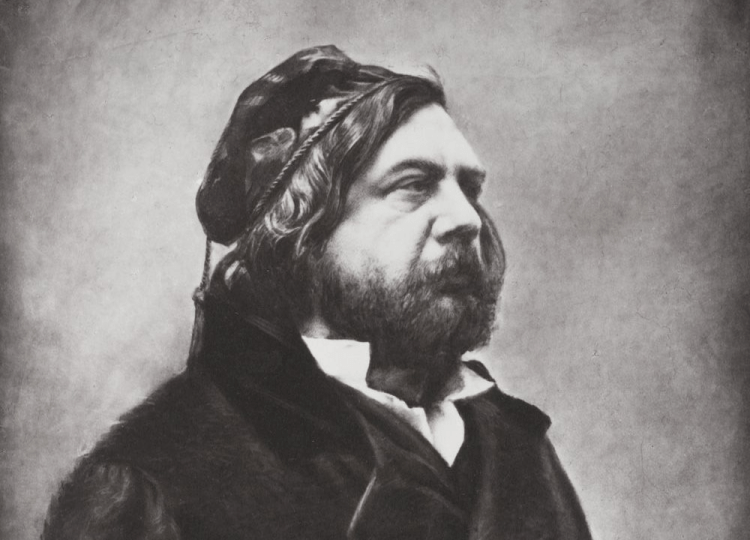
By Théophile Gautier
Translated by Samuel Lees
I. The Pimodan Hotel
One evening in December, responding to a mysterious summons, set down in enigmatic terms ― understood by the initiated, meaningless to anyone else ― I found myself in a remote neighbourhood, a sort of solitary oasis in the middle of Paris, which the river folds in its arms as if to defend against the encroachments of civilisation. It was in an old house on the île Saint-Louis, the Pimodan hotel, built by Lauzun, that the strange club, of which I had recently become a member, held its monthly gatherings. I would be attending for the first time.
Though it was barely six o’clock, the night was black.
A fog, made thicker by the proximity to the Seine, enveloped the surroundings, broken here and there by the reddish glow of lanterns and the threads of gold that fell from lighted windows.
The pavement, awash with rain, glistened under the street lamps. A cold wind laced with shards of ice lashed the face. Its hoarse whistling formed the high notes of a symphony, while the heavy waves crashing against the arches of the bridge formed the bass. None of winter’s bleak poetry was lacking that evening.
It was difficult, along the deserted street, among the bulk of gloomy buildings, to find the right house. The driver, standing on his seat, could dimly make out the name of the old hotel on a marble plaque, the gathering place of the disciples.
I lifted up the carved knocker, the use of a doorbell with a leather button having not yet made its way into these remote parts. I heard the cord grate several times without success. At last, yielding to a more vigorous effort, the rusty bolt drew back, and the heavy portal turned upon its hinges.
As I entered, the head of the old porter appeared by the flickering light of a candle behind a pane of yellowish transparency, a perfect Schalcken painting. ― The porter gave me a ghastly grin; a bony finger, extending out of the cabin, pointed the way.
As far as I could make out, in the pale light that falls to earth even from the darkest sky, the courtyard I was crossing was surrounded by buildings of ancient architecture with pointed gables. My feet were wet, as if I had been walking through a meadow, as the cracks between the pavings were full of grass.
The narrow windows of the stairwell, glowing on the gloomy facade, acted as my guide and prevented me from losing my way.
I crossed the threshold and found myself at the bottom of one of those immense staircases such as those built during the reign of Louis XIV, and in which a modern house would dance with ease. ― An Egyptian chimera in the style of Lebrun, with a Cupid astride, rested its paws on a pedestal and held a candle in its claws.
The incline was gentle; the well-distributed landings attested to the genius of the old architect and the grand life of days gone by. As I climbed this admirable staircase, dressed in my slim black coat, I could not help feeling like a stain on the surroundings, that this was a privilege that did not belong to me; the service stairs would have been good enough for me.
Paintings, most of them without frames, copies of masterpieces of the Italian and Spanish schools, covered the walls, and above, partially visible in the shadows, was a great mythological ceiling painted al fresco.
A drum of Utrecht velvet, crushed and shimmering, whose yellow braid and bent nails told of long use, indicated the door.
I knocked; the doors were opened with the usual precautions. I found myself in a large room lit at one end by a number of lamps. It was as though I had stepped back two hundred years. Time, which passes so quickly, seemed not to have left a mark upon this house, and, like a clock that one has forgotten to wind, the hand still pointed to the same time.
The walls were covered with white panelling and darkened fabric which bore the stamp of the time. On the huge hearth stood a statue which could have been taken from Versailles. On the ceiling there was a crudely painted allegory in the style of Lemoine, and which might have been his work.
I made my way towards the illuminated part of the room, where several human forms stirred around a table. As I came into view, a hearty cheer shook the foundations of the building.
― That’s him! That’s him! cried several voices at once; let us give him his due!
The doctor stood by the sideboard on which a platter was to be found, bearing a number of little saucers of Japanese porcelain. A dollop of greenish paste or jam, about the size of a thumb, was extracted with a spatula from a crystal vase, and placed by a silver spoon on each saucer.
The doctor’s face beamed enthusiastically; he breathed heavily, his nostrils dilated, his eyes sparkled, his cheeks flushed red and his veins bulged at the temples.
― This will be deducted from your share in paradise, he told me as he handed me my portion.
Once each person had eaten their share, coffee was served in the Arab manner, in other words, with grounds and without sugar.
Then we seated ourselves at the table.
This reversal of culinary habits is no doubt a shock to the reader; indeed, it is hardly customary to have coffee before supper, and in general jam is only eaten with desert. This surely warrants an explanation.
II. An Aside
There was once a group of dangerous extremists commanded by a sheikh known as the Old Man of the Mountain, or prince of Assassins.
The Old Man of the Mountain was obeyed without question. His subjects, the Assassins, carried out his orders, whatever they may be, with absolute devotion. No danger could stop them, not even certain death. On his command, they would throw themselves from the top of a tower; they would attack a king in his palace, surrounded by his guards.
How did the Old Man of the Mountain obtain such fanatical devotion from his followers?
By means of a wonderful drug, of which he possessed the recipe, whose effect is to produce the most amazing hallucinations.
Upon waking from their delirium, those who had consumed the drug found real life so dismal and grey that they would happily sacrifice everything to return to the paradise of their dreams, as any man killed whilst carrying out the sheikh’s bidding went straight to heaven or, if he escaped, was welcomed back into the fold and invited once more to enjoy the pleasures of the mysterious compound.
The green paste that the doctor had just dished out among us was precisely the same substance that the Old Man of the Mountain fed his acolytes long ago without them suspecting, convincing them that he had at his disposal the heaven of Mohammed and its virgins ― in other words hashish, from which we get hashshashin, hashish-eater, the root of the word assassin, whose fierce connotations are explained by the bloody habits of the Old Man of the Mountain’s followers.
Of course, those who had seen me leave my home at the hour when ordinary mortals sup did not suspect that I was going to the île Saint-Louis, a virtuous place if ever there was one, to eat a strange dish which centuries ago served as a means for a deceitful sheikh to incite his followers to murder. There was nothing in my thoroughly middle-class appearance that would lead one to suspect me of these oriental excesses; I had the air rather of a nephew going to dine with an old aunt than a disciple about to taste the pleasures of Mohammed’s heaven in the company of twelve Arabs who could not possibly be more French.
Before this revelation, if someone had told you that there was in Paris in the year 1845, in this age of railways and financial speculation, a society of hashish-eaters of which Mr. de Hammer had not written the tale, you would never have believed it, and yet it is absolutely true ― such is the nature of the improbable.
III. The Banquet
The meal was served in a most unusual manner with all sorts of elaborate and colourful dishes.
Large Venetian glasses laced with milky spirals, German vidrecomes decorated with legends and coats of arms, Flemish jugs of enamelled pottery and slender-necked flagons bound in wicker replaced the ordinary glasses, bottles and decanters.
The porcelain of Louis Lebœuf and the floral English crockery that adorn the tables of the middle classes were conspicuous by their absence. No two plates were the same, but each had its own particular charm: here were the finest specimens from China, Japan and Saxony, each one a trifle cracked or broken, but all in exquisite taste.
The plates were mostly enamels of Bernard Palissy and ceramics from Limoges. Occasionally a knife would encounter, beneath the actual meat, the form of a reptile, frog or bird in relief. The fleshy coils of the eel tangled with those of the serpent below.
An honest philistine would have felt some alarm at the sight of these hirsute guests: bearded, moustachioed or shaved in a singular fashion, brandishing daggers from the sixteenth century, Malaysian kris and Spaniah navajas, and bent over their meals, to which the flickering light gave an unsavoury aspect.
The meal drew to an end. Some of the more devout members were already beginning to feel the effects of the green jam. I personally had experienced a complete alteration in taste. The water I drank tasted like the most exquisite wine. The meat changed to raspberries in my mouth, and vice versa. I could not tell a pork chop from a peach.
My neighbours began to appear somewhat unusual. Their eyes were large like an owl’s. Their noses grew into proboscises; their mouths gaped like bell bottoms and their faces flushed supernatural colours.
One among them, a pale face in a black beard, laughed uncontrollably at an invisible spectacle. Another made incredible efforts to lift his glass to his lips; his contortions elicited a clamorous response from his neighbours.
One fellow twitched nervously and twiddled his thumbs with incredible speed. Another, slumped in his chair with arms of lead, stared into space, drowning luxuriously in the bottomless sea of annihilation.
Leaning upon the table, I contemplated all this with the last crumbs of reason, which came and went at intervals like the flame of a dying candle. An invisible warmth coursed through my limbs, and madness, like a wave that breaks against a rock then withdraws only to hurl itself at it once more, came and left my brain, in the end flooding it entirely.
Hallucination, that strange guest, sat in the throne of my mind.
― The drawing room! everyone to the drawing room! shouted one of the guests. Do you not hear the heavenly choir? The musicians have been at their stalls for some time.
And indeed, a delightful harmony could be heard across the tumult of conversation.
IV. An Uninvited Guest
The drawing room was an enormous room with gold sculpted panelling, a painted ceiling, brocade curtains, a frieze showing satyres pursuing nymphs in the reeds and a huge chimney in coloured marble. All the grandeur of lost days was on display here.
Sofas and armchairs, large enough to allow the dresses of duchesses and marquesses to spread with ease, received the hashshashins in their soft and ever open arms.
The chair beside the fire was making advances at me. I settled into it and abandoned myself to the effects of the fantastic drug.
My companions began to disappear one by one, leaving no trace except their shadows on the wall, which soon absorbed them, just as the brown stains that water leaves upon the sand fade as they dry.
Beyond this point, since I was no longer conscious of their actions, you will have to content yourself with an account of my simple personal impressions.
Solitude reigned in the room, except for some dim lights scattered here and there. Then, all of a sudden, there was a red flash under my eyelids, a great number of candles ignited of their own accord and I was bathed in a pale warm light. The room was the same, differing only as a painting differs from a sketch: everything was bigger, richer and more magnificent. Reality served merely as the point of departure for the wonders of hallucination.
I still could not see anyone and yet I felt the presence of a multitude.
I heard the rustle of fabric, the clicking of court shoes, bursts of stifled laughter, the grating of chair and table legs. Voices whispered, murmured and lisped. The porcelain clattered. Doors opened and closed. There was something unusual going on.
A mysterious figure appeared suddenly before me.
How he got in, I have no idea and yet I was not at all fazed by the sight of him. He had a bird’s beak for a nose, green eyes with three brown rings around them, which he wiped frequently with his enormous handkerchief. A starched white tie choked his scrawny neck, causing the skin of his cheeks to overflow in red folds. A calling card was inserted in the knot of his tie which read: Daucus-Carota, of the Gold Pot. His plump form was encased in a black coat with square tails, from which bundles of charms depended. As to his legs, they were, I must confess, made of a mandrake root, black, bifurcated, rough, full of knots and warts, and which seemed only to have been recently unearthed, as particles of soil still adhered to the filaments. His legs wriggled and convulsed with remarkable energy and when the small torso which they bore hither and thither was directly opposite me, the strange individual suddenly burst into tears. Wiping his eyes vigorously, he said in the most plaintive voice:
― Today you will die of laughter!
And tears the size of peas rolled down his face.
― Of laughter… of laughter… echoed like a choir of shrill nasal voices.
V. Fantasia
I looked up at the ceiling and beheld a host of disembodied cherub’s heads. They had such comical expressions, such joyful and profoundly happy faces, that I could not help but take part in their mirth. ― Their eyes creased, their nostrils widened and their mouths expanded; a sight that would put a smile on the face of Sorrow in person. These fool’s masks moved in spheres turning in opposite directions, all together creating a hypnotic and vertiginous effect.
The drawing room gradually filled with extraordinary figures, of the kind one only finds in Callot’s etchings or Goya’s aquatints, a confused blend of rags and tatters, human and animal forms. On any other occasion, I might have been intimidated by such company, but there was nothing menacing in these monstrosities. It was the spirit of mischief, not savagery, that made their eyes sparkle. Laughter alone exposed their fangs.
As if I had been the king of the party, one by one each figure stepped forward into the circle of light whose centre I occupied and, with a ridiculous air of compunction, mumbled pleasantries in my ear, none of which left any trace upon my memory, but which, in the moment, seemed profoundly witty, and caused me the most hysterical joy.
With each new apparition, a laugh ― Homeric, Olympian, staggering, immense, and which seemed to echo to infinity ― erupted around me, rumbling like thunder.
Voices, shrill and deep in turn, cried:
― No, it’s too funny! That’s enough! My God, my God, I’m having so much fun!
― Stop! I can’t take any more… Ah! ha! ha! ha! hi! hi! ho! ho! What a farce! What a beautiful pun!
― Stop! I’m gasping for air! I’m suffocating! Don’t look at me like that… Oh, I think I’m going to burst…
In spite of these protestations, half joking, half desperate, the mirth continued to grow and the hullabaloo intensified. The walls of the house throbbed like a human diaphragm, shaken by this compulsive, relentless, hysterical laughter.
Then, instead of parading themselves before me one by one, the absurd ghosts attacked me en masse, shaking their long Pierrot sleeves at me, stumbling over the folds of their magician’s robes, breaking their cardboard noses in ridiculous clashes, forming clouds in the air with their powdered wigs and singing outrageous songs with impossible rhymes, completely out of tune.
All the characters spawned by the satirical imagination of artists and people were to be found here, but tenfold, one hundredfold in strength. It was a strange crowd: the Neapolitan pulcinella playfully hit the English punch in the back. The Bergamasque harlequin rubbed his black snout on the powdered mask of the French clown, who let out frightful screams. The Bolognese doctor flung tobacco in the eyes of father Cassander. Tartaglia galloped around on the back of a fool. Gilles kicked don Spavento in the bottom and Karagiozis, armed with his obscene stick, fought a duel with an Oscan jester.
Visions from whimsical dreams proceeded confusedly: hybrid creations, shapeless mixtures of man, beast and utensil: monks with wheels instead of feet and cauldrons for bellies, warriors clad in crockery brandished wooden sabres in their talons, mechanical statesmen operated by the gears of a turnspit, kings stogged to the waist in pepperpot bartizans, alchemists with heads shaped like bellows, their limbs twisted into alembics, whores made from pumpkins with odd bulges, everything that could be traced out in a fever of creative passion by a cynical person, while intoxication nudges his elbow.
They swarmed, crawled, trotted, jumped, growled and whistled, as Goethe says in the night of Walpurgis.
Seeking to distance myself from the exaggerated affability of these baroque characters, I took refuge in a dark corner, from whence I could observe them as they engaged in dances, such as were never seen during the Renaissance or in the time of Chicard, or at the Opera under the reign of Mussard, the king of the frenzied quadrille. These dancers, a thousand times superior to Moliere, Rabelais, Swift and Voltaire, wrote, with an entrechat or a balancé, comedies so profoundly philosophical, satires so penetrating and witty, that I was rendered helpless with laughter.
Daucus-Carota performed pirouettes and cabrioles that defied belief, particularly for a man with his legs. Wiping his eyes, he repeated in a grotesquely pitiful voice:
― Today you will die of laughter!
Oh you who have admired the sublime silliness of Odry, the hoarse absurdity of Alcide Tousez, the raucous stupidity of Arnal, the apish grins of Ravel, and who think you know what a comical mask looks like, if you could have attended this Gustave ball conjured up by hashish, you would agree that the most hilarious comedians of our little theatres would make better graveyard statues.
What strangely contorted faces! eyes sparkling with scorn beneath their bird membranes! grins like slits, mouths like axe wounds! such facetiously dodecahedral noses! and bellies full of pantagruelian jibes!
Through this teeming mass of nightmares without anguish, sudden likenesses of an irresistible effect appeared fleetingly, as if illuminated by flashes of lightning, caricatures that would make Daumier and Gavarni green with envy, fantasies that would make the great chinese artists swoon, the Phidiases of caricatures and comical figurines!
Not every vision was monstrous or grotesque. Grace was also present in this carnival of forms. Near the chimney, a small chubby man with golden curls rolled about the floor in an interminable access of joy, disclosing a set of thirty-two teeth like grains of rice, and emitting a long peel of rich, silvery laughter, enchased with trills and pauses, which reached my ear with hypnotic effect, compelling me to commit a number of excesses.
The joyous frenzy had reached its climax. One heard nothing but convulsive sighs and inarticulate clucking. Laughter gave way to grunting; spasms followed pleasure. Daucus-Carota’s refrain was going to come true.
Several exhausted hashish-eaters had already rolled onto the floor with that gentle languor that makes falling over while intoxicated almost safe. Exclamations such as: ‘My God, how happy I am! What bliss! I’m swimming in ecstasy! I’m in paradise! I am plumbing the very depths of pleasure,’ intersected and became confused. It was time to throw a drop of cold water on this scolding vapour, or the boiler would explode.
The human body, which has so little strength for pleasure, and such a great capacity for pain, could not tolerate a higher pressure of joy.
One among our number, who took no part in the voluptuous intoxication in order to watch over the fantasia and to prevent those who thought they had wings from throwing themselves out of a window, took his seat at the piano. His hands, descending at once, sank into the ivory, and a glorious harmony resonated with a force that silenced the general murmur and altered the course of the evening.
VI. Kif
The theme was, I believe, Agathe’s song from the Freyschütz. This celestial melody, like a breeze that sweeps away a foul smell, scattered the ridiculous visions that had been obsessing me. The grimacing larvae wriggled away, crawling under the armchairs; they hid between the folds of the curtains, sighing faintly. Once more it seemed that I was alone in the drawing room.
The giant organ of Fribourg cathedral, I’m sure, does not create a volume of sound as great as that produced on the piano played by the seer (the name given to the sober disciple). The notes resonated with such power, piercing my chest like arrows of light. The air being played seemed to emanate from within me. My fingers played upon an invisible keyboard. The sounds flowed out red and blue, in electric sparks. Weber’s soul had been incarnated in me.
After the piece was over, I continued with interior improvisations in the style of the German master which caused me transports of indescribable pleasure. What a shame that there was not a magical stenographer on hand who could have received these inspired melodies, heard by me alone, and which I do not hesitate, modest as I am, to place above the masterpieces of Rossini, Meyerbeer and Felicien David.
Oh Pillet! oh Vatel! one of the thirty operas I produced it ten minutes would have made you rich in six months.
The somewhat violent pleasure of the start was succeeded by an indefinable well-being, a calm without limits.
I was in the blissful period of hashish which the orientals call kif. I no longer felt any physical sensation in my body. The bonds between mind and spirit had been severed. I moved at will through a medium that offered no resistance.
It is thus, I imagine, that souls move in the ethereal world we go to after death.
A bluish vapour, an Elysian day, a reflection from an azure cave, formed an atmosphere in the room in which everything looked hazy. This atmosphere, both warm and cool, humid and perfumed, folded me, like the water in a bath, in its sweet embrace. When I moved, the air made a thousand voluptuous swirls around me. An exquisite languor steeped my senses and tipped me onto the sofa where I fell like an abandoned garment.
I understood then the pleasure which spirits and angels experience, according to their degree of perfection, in passing through the ether and the heavens, and how eternity is spent in paradise.
This euphoria was not contaminated by anything material; no earthly desire altered its purity. Besides, love itself could not have improved it. Romeo the hashshashin would have forgotten all about Juliet. The poor child, leaning on the jasmine, would have held her beautiful alabaster arms out across the night in vain. Romeo would have remained at the bottom of the silk ladder, and, though I am completely in love with the angel of youth and beauty created by Shakespeare, I must confess that the most beautiful girl in Verona, for a hashshashin, is simply not worth the bother.
I watched with a peaceful eye, charmed by the circle of immaculately beautiful women that crowned the frieze with their divine nudity. I saw their satin shoulders shine, their silvery bosoms sparkle, their little pink-soled feet rise, their opulent hips sway, without feeling the slightest temptation. The charming spectres that troubled saint Anthony would have had no power over me.
By a strange miracle, after a couple minutes of contemplation, I would melt into the object upon which I fixed my attention and become that object.
Thus I was transformed into a nymph, because the fresco represented Ladon’s daughter being pursued by Pan.
I felt the terror of the poor fugitive, and I tried to hide behind the fantastical reeds to escape the monster with the legs of a goat.
VII. The Kif Turns into a Nightmare
During my trance, Daucus-Carota had returned.
Sat like a pasha on his neatly folded roots, he fixed his fiery eyes upon me. His beak snapped in such a taunting manner and an attitude of such scornful triumph animated all of his small deformed being, that I shuddered despite myself.
Sensing my dismay, he increased his contortions and grimaces, and approached, bounding like a disabled daddy longlegs or a legless cripple.
I felt a cold breath in my ear, and a voice whose accent was well-known to me, though I could not place it, told me:
― This miserable Daucus-Carota, who sold his legs for a drink, has stolen your head and put in its place, not the head of an ass ― as Puck does to Bottom ― but the head of an elephant!
Singularly intrigued, I went over to the mirror, and saw that it was true.
I could have been mistaken for a hindu or javanese idol. My forehead had risen, my nose was drawn out into a trunk and curled at my waist; my ears brushed against my shoulders and, to add to my troubles, I was the colour indigo, like Shiva, the blue god.
Apoplectic with rage, I went in pursuit of Daucus-Carota, who bounced and shrieked, and gave every indication of extreme terror. I managed to catch him, and I knocked his head on the edge of the table with such violence that in the end he agreed to return my head, which he had wrapped in his handkerchief.
Satisfied with this victory, I went to take my place once again on the sofa, but the same little unknown voice whispered:
― Beware, you are surrounded by enemies. Invisible forces are trying to lure you and keep you from going. You are a prisoner here. Try to leave and you will see.
The veil had been torn from my eyes. It became clear to me that the other members of the club were magicians and kabbalists who wanted to lead me to my destruction.
VIII. Treadmill
I managed to get up, not without a lengthy struggle, and made my way to the door, which I only reached after a considerable delay, an unknown power forcing me back every third step. By my calculations, the journey must have taken me ten years.
Daucus-Carota pursued me, sneering and muttering with an air of sarcastic commiseration:
― If he continues at this pace, he’ll be an old man by the time he gets there.
I reached the neighbouring room, whose dimensions had altered beyond recognition. They stretched out… forever. The light which glowed at the end of the room seemed as distant as the stars.
I fell into despair. I was just about to give up when the soft voice said, almost brushing my lips:
― Be brave! she’s expecting you at eleven o’clock.
Mustering all my strength, I succeeded, by an enormous exertion of the will, to lift my feet, which had been nailed to the ground and which I had to prise like tree trunks. The monster with the mandrake legs dogged me, mocking my efforts and singing in the style of psalm:
― The marble is taking hold! the marble is taking hold!
And, sure enough, I felt my legs turning to stone. The marble rose up to my hips, like Daphne in the Tuileries. I was a statue up to waist, like the enchanted princes of the Thousand and One Nights. My solid heels beat loudly upon the floorboards: I could have played the Commander in Don Juan.
I reached the landing of the staircase, which I made efforts to descend. It was dimly lit and assumed gigantic and monstrous proportions in my mind. Its ends, steeped in shadows, seemed to plunge into heaven and hell, two chasms. Lifting my head, I saw a prodigious spectacle: a superposition of endless landings, slopes to scale like those leading to the top of the tower of Babel. Looking down, I saw an abyss of stairs, a spiralling vortex, vertiginous convolutions.
― These stairs must go from one end of the earth to the other, I thought as I continued my mechanical march. By the time I reach the end, it will be the day after Judgement.
The figures in the paintings gave me looks full of pity. Some suffered painful contortions, like a mute who has something important to say on a very momentous occasion. It was as if they wanted to warn me of a trap, but a dismal inert force pushed me on. The steps were spongy and sunk under my feet like the mysterious ladders in Freemason trials. The soft and sticky stones sagged like a toad’s belly. An endless succession of stairs and landings appeared before my weary steps. Those I left behind replaced themselves in front of me.
This merry-go-round lasted for a thousand years, by my count.
I finally reached the vestibule. There, another trial, no less terrible, awaited me.
The chimera grasping a candle in its claws, which I had noticed on the way in, blocked my path with evidently hostile intentions. Its green eyes sparkled with irony; its sly mouth laughed cruelly. It came toward me, dragging its bronze caparison in the dust, but this it did not in submission. Its lioness hind shook with ferocious convulsions. Daucus-Carota roused it like a dog before a fight:
― Bite him! bite him! marble meat for a bronze mouth, there’s a kingly caper.
Without letting myself be intimidated by the horrible creature, I passed outdoors. I was struck by a flurry of cold air; the night sky appeared suddenly before me, free of clouds. A sea of stars strewed the heavens with points of gold.
I was in the courtyard.
To convey the effect that the gloomy architecture produced on me would require the same needle Piranesi used to etch the black varnish of his marvellous copperplates. The courtyard had, in the space of a few hours, expanded to the proportions of the Champ de Mars, bound by giant edifices that cleft the horizon with needles, domes, towers, gables and pyramids worthy of Rome and Babylon.
I was completely taken aback. I had never suspected that the île Saint-Louis contained such monumental greatness, which otherwise would cover twenty times its actual area. I thought, with not a little apprehension, of the power of the magicians who could, over the course of an evening, raise such constructions.
― You are the toy of vain illusions. This courtyard is very small, murmured the voice. It’s only twenty-seven paces long and twenty-five paces wide.
― Yes, yes, snarled the bifurcated monstrosity, twenty-seven paces with seven-league boots*. You’ll never get there by eleven o’clock. It’s been fifteen hundred years since you left. Your hair is already going grey… Go back up; it’s the wisest thing to do.
As I did not comply, the odious monster seized me between the reeds of his legs, and, using his hands like hooks, dragged me back, despite my efforts to resist, up the stairs which had caused me so much turmoil and installed me once again, to my great despair, in the drawing room from whence I had escaped with such difficulty.
I was completely overwhelmed by a feeling of dizziness. I became mad, delirious.
Daucus-Carota was doing pirouettes up to the ceiling, saying:
― You idiot! I may have returned your head, but before that I scooped your brains out with a spoon.
I felt a terrible sadness, as, raising my hand to my head, I found it open, and I fainted.
IX. Don’t Believe the Clocks
When I came to, I found the room full of people dressed in black. They greeted me with a tragic air and shook my hand with melancholic cordiality, like people suffering from a common pain.
They said:
― Time is dead. From now on there will be no more years, months or hours. Time is dead and we’re going to his funeral.
― It’s true that he was very old, but it was still a surprise. He handled himself very well for his age, added one of the people in mourning whom I recognised as a painter friend of mine.
― Eternity is old hat now. It had to come to an end, said another.
― Good God! I cried, struck by a sudden thought, if there’s no more time, when will it be eleven o’clock? …
― Never! Daucus-Carota roared, with his nose in my face, revealing himself to me in his true form… Never… it will always be a quarter past nine… The hands will remain where they were when time ceased to exist, and your punishment will be to come and look at the motionless hand and then return to your seat, going back and forth until your heels are worn to the bone.
A higher power seized control of me, and I made the journey four or five hundred times, consulting the clock with a horrible dread.
Daucus-Carota sat astride the pendulum and pulled hideous faces at me.
The hands did not move.
― You miserable wretch! you stopped the pendulum, I yelled, drunk with rage.
― Not at all, it’s swinging back and forth as usual… but the suns will fall to dust before this silver arrow moves a millionth of a millimetre.
― The evil spirits must be exorcised, things are getting grim, said the seer. Let us play some music. David’s harp will be replaced this time by an Erard piano.
And, taking his seat, he played a jaunty melody…
This seemed greatly to upset the mandrake-man, who shrank, withered and groaned inarticulately. Eventually he lost all semblance of humanity, and rolled to the floor in the shape of an oyster plant with a pair of shrivelled roots.
The spell was broken.
― Hallelujah! Time has been restored, cried the sunny childish voices. Go look at the pendulum now!
The hands pointed to eleven o’clock.
― Sir, your cab is waiting downstairs, the servant informed me.
The dream was over.
The hashshashins went their separate ways, like the officers after Marlborough’s funeral.
I glided down the stairs that had caused me such tribulations, and moments later I was back in my room full of reality. The last vapours of hashish had disappeared.
My reason had returned, or at least what I call reason, for want of a better name.
I was lucid enough to grasp a pantomime or a vaudeville, or to compose verses rhyming three letter words.
Notes
Seven-league boots (Bottes de sept lieues) ― magic boots in Perrault’s Contes (Fairy Tales) which allow the wearer to travel seven leagues in a single stride.
 Samuel Lees